On January 17, 2026, the Traffic Police Department under the Ministry of Public Security confirmed that it is currently researching and advising the government on the issuance of a new decree to replace Decree 168/2024/NĐ-CP, which has garnered significant attention across online forums.
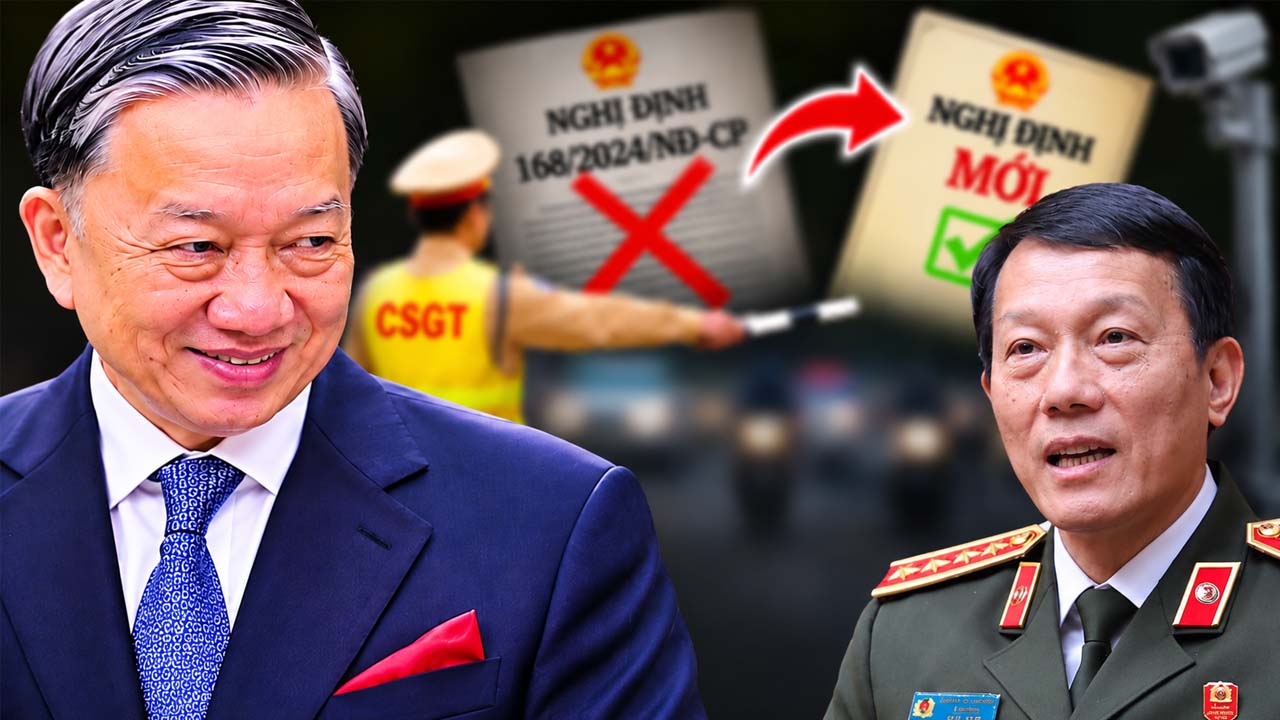
After nearly two years in effect since early 2025, this legal document—noted for its “harsh” penalty frameworks featuring steep fines and a strict driver’s license demerit point system—is now likely to be adjusted to be more appropriate.
However, amid public expectations, the current legal reality calls for a more thorough examination of the underlying rationale behind the Ministry of Public Security’s decision to adjust this policy.
Accordingly, the drafting authority is considering a plan to tier fines based on the number of violations, reducing penalties to a warning or merely deducting driver’s license points for first-time unintentional offenses that have not caused accidents.
At the same time, clearly distinguishing sensitive situations—such as running a yellow light or making a right turn without causing a traffic conflict—is considered a necessary step back to align with real-life circumstances.
Over the past nearly two years, the rigid application of exorbitant fines—such as fines ranging from 18 to 20 million VND for cars and from 4 to 6 million VND for motorcycles for a single instance of failing to obey a traffic signal, or the maximum fine of up to 40 million VND for alcohol-related violations—has revealed numerous shortcomings.
In this context, where transportation infrastructure in many major cities remains underdeveloped and the system of traffic signs and signals is sometimes unclear or inaccurate, drivers often find themselves confused.
Treating a momentary technical error as an intentional disregard for the law places excessive financial pressure on the incomes of the vast majority of workers, while also creating persistent disparities between the severity of the offense and the penalty.
Notably, the Ministry of Public Security has now mandated the use of transparent electronic evidence during the violation processing. This is seen as a decision that directly addresses the biggest loophole in traffic violation enforcement to date.
With fines rising to tens of millions of dong, coupled with the risk of losing all 12 points on a driver’s license each year, citizens’ freedom of movement and livelihoods depend heavily on the objectivity of traffic police officers.
Public opinion holds that the lack of clear visual evidence—such as photos and video clips—in many past situations has placed road users at a disadvantage, increased skepticism regarding the transparency of the penalty process, and created negative loopholes prone to abuse.
Therefore, establishing mandatory standards for electronic evidence not only helps protect citizens’ legal rights but also serves as a tool for “reverse oversight” of the traffic police’s own discipline on the streets.
However, all of the aforementioned changes have so far remained at the level of policy research guidelines, tied to draft laws currently under consideration by the National Assembly, and have not yet taken effect.
Looking at the bigger picture, the process of amending Decree 168 after two years of implementation also demonstrates that, ultimately, traffic laws are not tools designed to maximize revenue from fines, but rather to ensure public safety and maintain social order in a humane manner.
The shift from the Ministry of Public Security’s long-standing mindset of “imposing heavy fines as a deterrent” to a mindset of “flexible enforcement, holding the right person accountable for the right offense”—if genuinely implemented—would be a significant step forward in restoring public trust in the fairness of state law.
Trà My – Thoibao.de
=======
Replacing Decree 168 After Nearly Two Years of Implementation: Will the Ministry of Public Security Address the Loopholes and Shortcomings?
“…A proposal to replace the Ministry of Public Security’s Decree 168 after nearly two years of implementation aims to resolve and address the shortcomings regarding traffic fines that have been a source of controversy.”
#Vietnam #ChinhTruongVN #Thoibao